
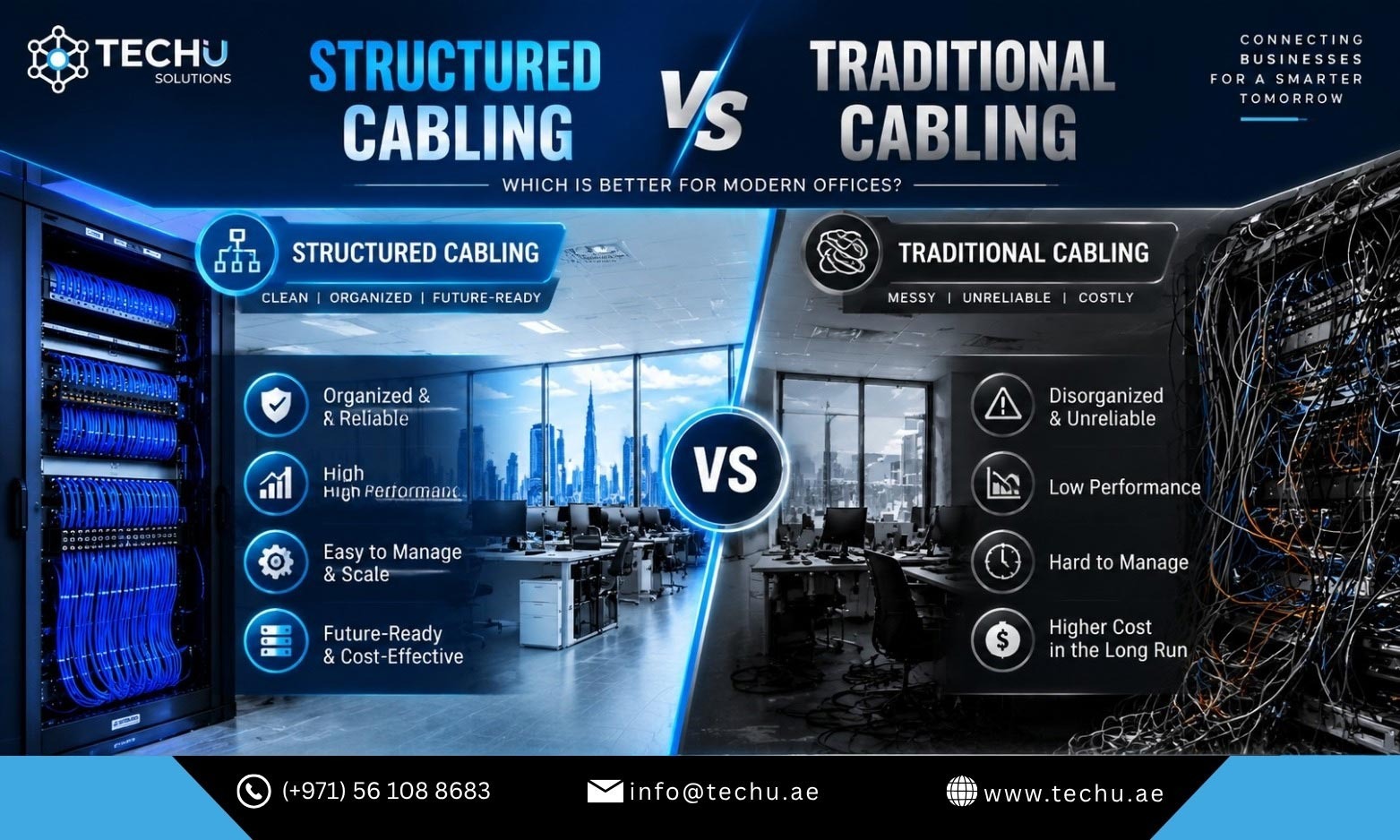
Structured Cabling vs Traditional Cabling: Which Is Better for Modern Offices?
In today’s digital workplace, a reliable network infrastructure is no longer optional. Businesses depend on internet connectivity, cloud applications, VoIP systems, CCTV surveillance, access control systems, and countless connected devices to operate efficiently. The foundation of all these technologies lies in the cabling system used throughout the office.
When planning a new office setup or upgrading an existing network, many business owners face an important question: Should they choose structured cabling or stick with traditional cabling?
Understanding the differences between these two approaches can help organizations make a smarter long-term investment.
Businesses looking for a reliable structured cabling service in Dubai are increasingly choosing organized network infrastructures that support long-term growth, performance, and scalability.
What Is Traditional Cabling?
Traditional cabling is a configuration in which separate cables are established for certain systems or devices as needed. Every time new equipment is launched, additional cables are added over time.
For example:
- Separate cables for computers
- Separate cables for telephones
- Individual wiring for security systems
- Additional cables for network expansion
While this method may seem simple initially, it often results in a tangled network of cables that becomes difficult to manage as the business grows.
Advantages of Traditional Cabling
- Lower initial installation cost
- Suitable for very small offices
- Simple setup for limited devices
Limitations of Traditional Cabling
- Difficult troubleshooting
- Poor scalability
- Cable clutter
- Higher maintenance costs
- Increased downtime during upgrades
As businesses expand, these limitations can significantly impact productivity and network performance.
What Is Structured Cabling?
Structured cabling is a standardized and organized cabling system designed to support multiple communication technologies through a unified infrastructure.
Instead of running separate cables for each system, structured cabling creates a central network architecture that supports:
- Internet connectivity
- Data networks
- VoIP phones
- CCTV systems
- Access control systems
- Wireless networks
- Smart office technologies
A professional structured cabling service in Dubai helps businesses design and implement a network infrastructure that supports current operational requirements while remaining ready for future technology upgrades.
Key Differences Between Structured Cabling and Traditional Cabling
- Organization
When more devices are added, traditional cabling frequently gets disorderly.
Structured cabling makes the network as a whole easier to comprehend and maintain by adhering to a planned topology with appropriate labeling, routing, and cable management.
- Scalability
New equipment and technology are continuously added by modern enterprises.
Every addition might require additional cable lines and changes when using traditional cables.
Because structured cabling is built to grow, companies may extend their infrastructure without experiencing significant interruptions.
- Maintenance and Troubleshooting
Locating faults in a traditional cabling environment can be time-consuming.
Structured cabling simplifies troubleshooting because every connection is documented and organized. Network issues can often be identified and resolved much faster.
- Performance
Interference, signal deterioration, and decreased network efficiency can result from poor cable management.
In order to guarantee uniform performance over the network, structured cabling adheres to industry standards.
- Long-Term Cost
Although traditional cabling might seem cheaper at first, maintenance, upgrades, and repairs can become more expensive over time.
Structured cabling can offer better ROI compared to traditional cabling since it mitigates business losses due to downtime and caters to growth.
Why Modern Offices Prefer Structured Cabling
Modern Offices are now more demanding with their reliance on technology to complete daily tasks using cloud software, business communications software, wireless devices, and smart building technology.
Having a well-organized network cabling structure offers the following benefits:
Improved Productivity
Employees experience fewer connectivity issues, helping them stay focused on their work.
Easier Expansion
New workstations, new departments, and new technologies can be added to the network without having to overhaul the entire network cabling.
Better Reliability
Structured cabling minimizes network disruptions and supports stable communication between devices.
Enhanced Professional Appearance
Facility management is simplified by organized cabling and server systems, so a well-organized server and cabling system reflects professionalism.
Future-Ready Infrastructure
As technology evolves, structured cabling can support new applications and higher bandwidth requirements more effectively than traditional cabling systems.
Which Solution Is Better for Your Business?
For small offices with only a few devices and no plans for expansion, traditional cabling may meet basic requirements.
However, for most modern businesses, structured cabling offers clear advantages in terms of:
- Network reliability
- Scalability
- Performance
- Maintenance
- Long-term cost efficiency
Whether you operate a corporate office, retail store, warehouse, educational facility, or commercial building, structured cabling provides a stronger foundation for future growth.
How TechU Solutions Helps Businesses Build Better Networks
TechU Solutions provides quality professional structured cabling solutions. Our team ensures calm and orderly systems that facilitate fast data and seamless communication and scaling.
As a provider of structured cabling service in Dubai, TechU Solutions delivers customized cabling solutions for offices, commercial buildings, warehouses, retail spaces, and other business environments.
From office networks and data centers to CCTV systems and wireless infrastructure, we help businesses create reliable network foundations that support long-term operational success.
Final Thoughts
The choice between structured cabling and traditional cabling ultimately comes down to your business goals. While traditional cabling may work for basic setups, it often struggles to meet the demands of modern workplaces.
Structured cabling helps create a clean, organized, professional, and scalable infrastructure that also minimizes ongoing costs. Structured cabling offers an alternative that focuses on smart investments and business growth for companies that want to enhance their networks.
Frequently Asked Questions (FAQs)
Q1. What is the main difference between structured cabling and traditional cabling?
Ans. A large amount of traditional cabling consists of cables that are added one by one around a network. A heavily populated network with individually added cables can be difficult to maintain and manage. In contrast, structured cabling uses a single network to support multiple systems and employs standardized, systematic cabling.
Q2. Why is structured cabling important for modern offices?
Ans. Structured cabling provides modern offices with a reliable base that supports the structure of the various systems the office integrates, such as the internet, cloud, VoIP, CCTVs, and wireless systems. Because structured cabling is systematic and standardized, support for additional systems is simple and efficient.
Q3. Is structured cabling more expensive than traditional cabling?
Ans. The costs of the initial installation of structured cabling are often more than those of traditional cabling. However, in comparison to traditional cabling, structured cabling reduces costs of maintenance and support, and is a more valuable solution over time.
Q4. Can structured cabling support future business growth?
Ans. Yes, the design and construction of structured cabling supports the addition of new technologies and devices.
Q5. How long does a structured cabling system last?
Ans. Structured cabling systems can last from 10 to 20 years or more and are designed based on the future needs of technology.
Q6. Does structured cabling improve network performance?
Ans. Yes. Properly organized cabling reduces signal interference, improves network reliability, and helps maintain consistent data transmission speeds across the network.